Blood tests for contact sports: rugby, football, martial arts
Contact and match days move your muscle markers for days. A pre-season baseline, taken away from games and weight cuts, gives you numbers to compare with.
Why it makes sense at this stage
What the research supports, with the source of each point at the bottom of the page.
- 01
Contact hurts the muscle, and CK shows how much
After rugby matches, CK peaked 24 hours later, and the peak rose with the number of tackles. It is the marker that moves most in contact sport.[1]
- 02
Recovery from a match takes more than 72 hours
In a review of 77 studies of football players, CK, hamstring strength and muscle soreness were still changed 72 hours after the match. A test the day after a game shows the game, not your baseline.[2]
- 03
UK winters lower players' vitamin D
In Premier League players, vitamin D fell from August to December, and 65% were under 50 nmol/L in winter. In another UK study, 62% of professional athletes were under 50 nmol/L in winter.[3, 4]
- 04
In martial arts, making weight changes the body and the blood
About half of combat sport athletes lose weight fast, with methods such as diuretics, laxatives, plastic suits and saunas that harm performance and health. A test in the middle of a weight cut is not your baseline.[5]
- 05
A knock to the head is for a clinician, not a blood test
Blood markers for concussion are still research tools, without enough evidence for clinical use. If you have had a knock to the head, follow your club's concussion process and see your GP.[6, 7]
The tests and why
What usually makes sense for this group. Your GP can tell you what fits your own case.
CK (creatine kinase)
The muscle enzyme. Tackles and contact raise it, and it can stay up for three days after a match. It is the fatigue marker of team sport, read against your own value.[1, 2, 8, 9]
When to repeat: Pre-season and mid-season, always at least 72 hours after a match, at the same point in the week.
Urea and kidneys (creatinine, eGFR)
Kidney function and training load. Test away from a weight cut, so the result shows your usual state.[5, 10]
When to repeat: With your season panel.
Vitamin D, 25(OH)D
Your vitamin D level. Many UK players are low by December.[3, 4, 11]
When to repeat: Late autumn or winter; after supplements, as your GP advises.
What a blood test can and cannot do
It can
- Show how much contact raises your CK, against your own baseline
- Show your vitamin D as winter comes in
- Give you a pre-season baseline to compare the season with
It cannot
- Assess a head injury: concussion is assessed by a clinician, not by a blood test
- Clear you to play: that is a clinical decision
- Read a high CK as an injury: it rises with a normal match
Tests that cover these markers
Not sure which one? The guided check-up suggests a starting point in a few questions.
Find your check-up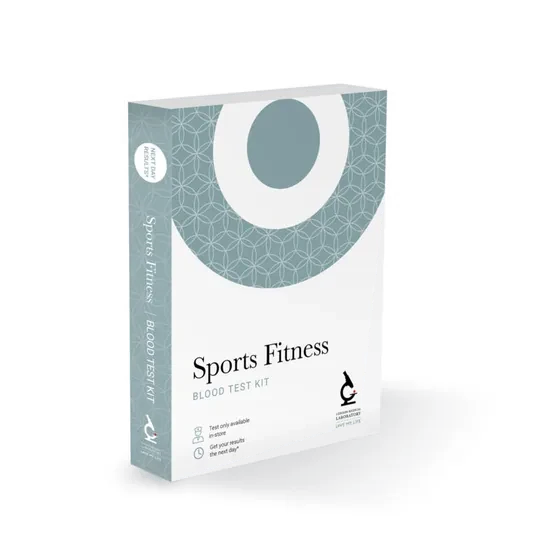
Sports Fitness Profile
The core panel: CK, urea and kidneys, full blood count, iron and ferritin, CRP, vitamins D and B12, liver, cholesterol and testosterone. At a collection point.
Collection pointResult in about 1 working daySee the test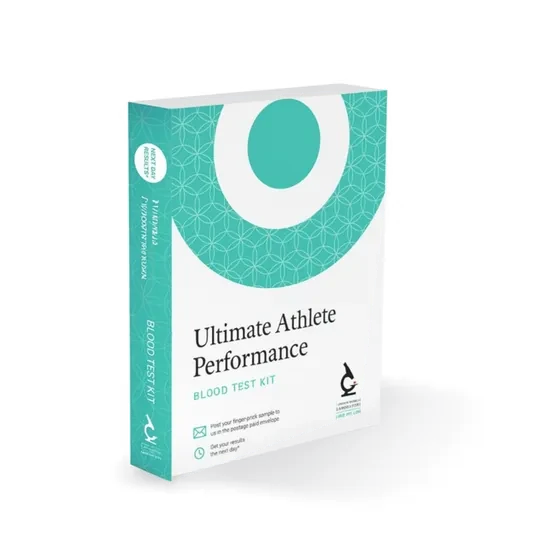
Ultimate Athlete Performance
Everything in the core panel plus HbA1c, the full thyroid, sodium, cortisol and sex hormones. At a collection point.
Collection pointResult in about 1 working daySee the test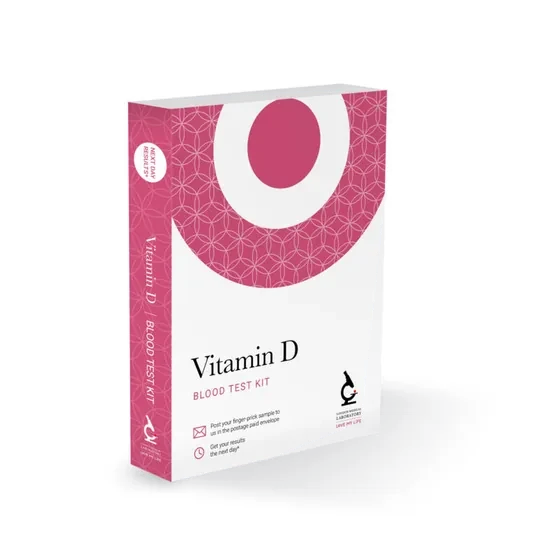
Vitamin D
Your 25(OH)D level, with a home kit, best checked in late autumn or winter.
Home kitCollection pointResult in about 1 working daySee the test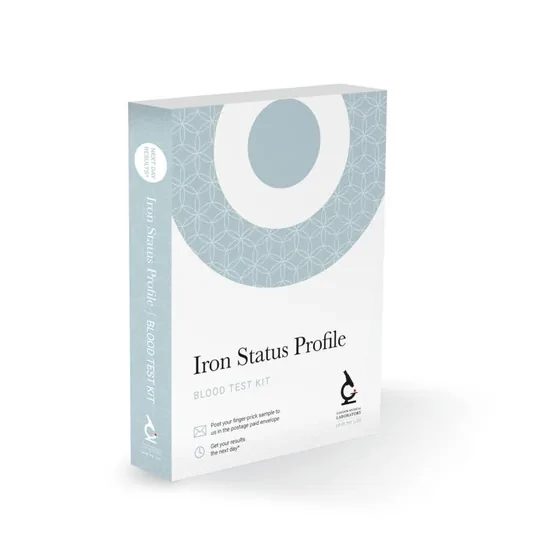
Iron and iron stores
Ferritin, iron and transferrin saturation, with a home kit: the iron picture on its own.
Home kitCollection pointResult in about 1 working daySee the test
Prices are in the app, once you have an account.
What to do with your result
Your result arrives in your account, with reference ranges. A value outside the range, or a symptom with a normal result, is a conversation with your GP: treatment and supplements are their call. Repeat the same test later to compare.
Take the guide with you
The reasons, the tests and every reference, in a few pages. Free to download, no email needed.
References
- 1.Takarada Y. Evaluation of muscle damage after a rugby match with special reference to tackle plays. Br J Sports Med. 2003;37:416-419. doi:10.1136/bjsm.37.5.416 PMID 14514532.
- 2.Silva JR, Rumpf MC, Hertzog M, et al. Acute and Residual Soccer Match-Related Fatigue: A Systematic Review and Meta-analysis. Sports Med. 2018;48:539-583. doi:10.1007/s40279-017-0798-8 PMID 29098658.
- 3.Morton JP, Iqbal Z, Drust B, Burgess D, Close GL, Brukner PD. Seasonal variation in vitamin D status in professional soccer players of the English Premier League. Appl Physiol Nutr Metab. 2012;37:798-802. doi:10.1139/h2012-037 PMID 22554144.
- 4.Close GL, Russell J, Cobley JN, et al. Assessment of vitamin D concentration in non-supplemented professional athletes and healthy adults during the winter months in the UK: implications for skeletal muscle function. J Sports Sci. 2013;31:344-353. doi:10.1080/02640414.2012.733822 PMID 23083379.
- 5.Franchini E, Brito CJ, Artioli GG. Weight loss in combat sports: physiological, psychological and performance effects. J Int Soc Sports Nutr. 2012;9:52. doi:10.1186/1550-2783-9-52 PMID 23237303.
- 6.McCrea M, Meier T, Huber D, et al. Role of advanced neuroimaging, fluid biomarkers and genetic testing in the assessment of sport-related concussion: a systematic review. Br J Sports Med. 2017;51:919-929. doi:10.1136/bjsports-2016-097447 PMID 28455364.
- 7.Tabor JB, Brett BL, Nelson L, et al. Role of biomarkers and emerging technologies in defining and assessing neurobiological recovery after sport-related concussion: a systematic review. Br J Sports Med. 2023;57:789-797. doi:10.1136/bjsports-2022-106680 PMID 37316184.
- 8.Hecksteden A, Skorski S, Schwindling S, et al. Blood-Borne Markers of Fatigue in Competitive Athletes - Results from Simulated Training Camps. PLoS One. 2016;11:e0148810. doi:10.1371/journal.pone.0148810 PMID 26891051.
- 9.Hecksteden A, Pitsch W, Julian R, et al. A New Method to Individualize Monitoring of Muscle Recovery in Athletes. Int J Sports Physiol Perform. 2017;12:1137-1142. doi:10.1123/ijspp.2016-0120 PMID 27967274.
- 10.Haller N, Behringer M, Reichel T, et al. Blood-Based Biomarkers for Managing Workload in Athletes: Considerations and Recommendations for Evidence-Based Use of Established Biomarkers. Sports Med. 2023;53:1315-1333. doi:10.1007/s40279-023-01836-x PMID 37204619.
- 11.Farrokhyar F, Tabasinejad R, Dao D, et al. Prevalence of vitamin D inadequacy in athletes: a systematic-review and meta-analysis. Sports Med. 2015;45:365-378. doi:10.1007/s40279-014-0267-6 PMID 25277808.
- 12.Clénin G, Cordes M, Huber A, et al. Iron deficiency in sports - definition, influence on performance and therapy. Swiss Med Wkly. 2015;145:w14196. doi:10.4414/smw.2015.14196 PMID 26512429.
- 13.Sim M, Garvican-Lewis LA, Cox GR, et al. Iron considerations for the athlete: a narrative review. Eur J Appl Physiol. 2019;119:1463-1478. doi:10.1007/s00421-019-04157-y PMID 31055680.
- 14.Pedlar CR, Brugnara C, Bruinvels G, Burden R. Iron balance and iron supplementation for the female athlete: A practical approach. Eur J Sport Sci. 2018;18:295-305. doi:10.1080/17461391.2017.1416178 PMID 29280410.
General information, not personal medical advice. Talk to your GP about your own situation. Questions: write to [email protected] or message us in the app.