Blood tests for men from 40 to 59
From 40 the risks that give no symptoms start to count more. A blood test shows your numbers, and what to do about them is a talk with your GP.

Why it makes sense at this stage
What the research supports, with the source of each point at the bottom of the page.
- 01
From 40, the NHS itself checks your risk
From 40 to 74 the NHS offers a Health Check every 5 years, with a cholesterol test, and possibly a blood sugar test. It looks at the risk of heart disease, stroke, type 2 diabetes and kidney disease.[1]
- 02
Being a man, and over 50, makes high cholesterol more likely
High cholesterol does not usually cause symptoms. A blood test is the only way to know.[2]
- 03
Type 2 diabetes does not always cause symptoms
The NHS lists a higher risk from 40, or from 25 for people of South Asian, Chinese, Black African or Black Caribbean background.[3]
- 04
Early kidney disease gives no warning
There are usually no symptoms in the early stages. It is linked to getting older, high blood pressure and diabetes, and creatinine and eGFR come in the same sample.[4]
- 05
PSA is a choice to make with your GP, not a routine test
Routine PSA testing is not offered on the NHS, but you can ask your GP about it. In trials with 721,718 men, PSA screening made at most a small difference to prostate cancer deaths over 10 years, and it has harms to weigh.[5, 6]
The tests and why
What usually makes sense for this group. Your GP can tell you what fits your own case.
Cholesterol profile
From 40 the NHS Health Check looks at cholesterol. Men are more likely to have high cholesterol, and it gives no symptoms.[1, 2]
When to repeat: Every 5 years at the NHS Health Check; more often if your GP advises.
HbA1c (average blood sugar)
Type 2 diabetes does not always cause symptoms, and the risk rises from 40.[1, 3]
When to repeat: Every 5 years at the NHS Health Check, or as your GP advises.
Kidney function (creatinine, eGFR)
Early kidney disease usually has no symptoms.[1, 4]
When to repeat: With your cholesterol; more often with high blood pressure or diabetes.
Vitamin D, 25(OH)D
From October to early March, UK sunlight is not enough to make vitamin D.[7]
When to repeat: Once in late winter.
What a blood test can and cannot do
It can
- Show your numbers between NHS Health Checks
- Show your kidney function, which gives no early symptoms
- Give you numbers to talk through with your GP
It cannot
- Turn PSA into a routine check: it is a choice with your GP
- Assess your heart or clear you for exercise: it shows risk factors
- Explain tiredness or mood by testosterone alone, without sexual symptoms
Tests that cover these markers
Not sure which one? The guided check-up suggests a starting point in a few questions.
Find your check-up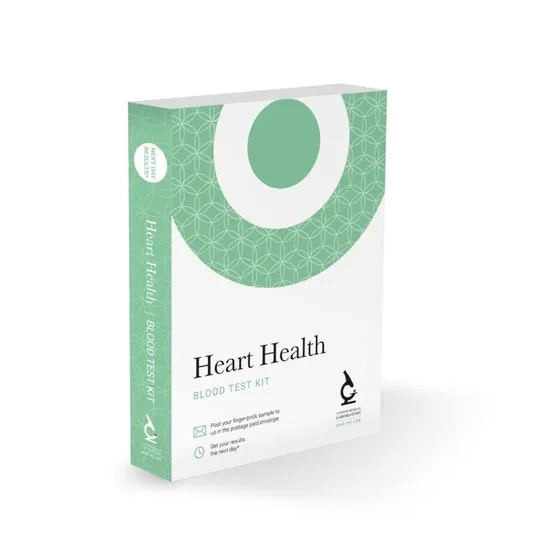
Heart Health Profile
Home kit with full cholesterol, HbA1c and high-sensitivity CRP. It has no kidney tests; for those, see the General Health Profile.
Home kitCollection pointResult in about 1 working daySee the test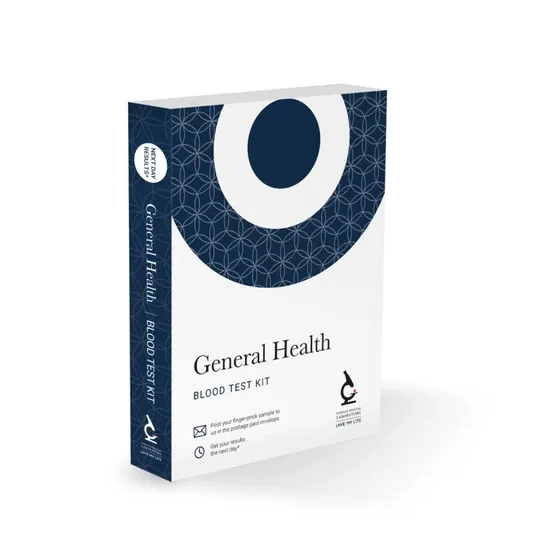
General Health Profile
Home kit with full cholesterol, HbA1c, liver, kidneys and uric acid.
Home kitCollection pointResult in about 1 working daySee the test
Vitamin D
Your 25(OH)D level, best checked in late winter.
Home kitCollection pointResult in about 1 working daySee the test
Well Man Premier Plus Profile
One test for all of it: cholesterol, HbA1c, kidneys, liver, blood count, ferritin, thyroid, vitamins and testosterone. It has no PSA. It needs a blood sample from a vein, at a collection point.
Collection pointResult in about 1 working daySee the test
Testosterone Plus
Total and free testosterone with SHBG and albumin, if you have symptoms.
Home kitCollection pointResult in about 1 working daySee the test
Prices are in the app, once you have an account.
What to do with your result
Your result arrives in your account, with reference ranges. A value outside the range, or a symptom with a normal result, is a conversation with your GP: treatment and supplements are their call. Repeat the same test later to compare.
Take the guide with you
The reasons, the tests and every reference, in a few pages. Free to download, no email needed.
See also
References
- 1.NHS. NHS Health Check. nhs.uk. 2026. www.nhs.uk/tests-and-treatments/nhs-health-check/
- 2.NHS. High cholesterol. nhs.uk. 2026. www.nhs.uk/conditions/high-cholesterol/
- 3.NHS. Type 2 diabetes: symptoms. nhs.uk. 2026. www.nhs.uk/conditions/type-2-diabetes/symptoms/
- 4.NHS. Chronic kidney disease. nhs.uk. 2026. www.nhs.uk/conditions/kidney-disease/
- 5.NHS. PSA test. nhs.uk. 2026. www.nhs.uk/tests-and-treatments/psa-test/
- 6.Ilic D, Djulbegovic M, Jung JH, et al. Prostate cancer screening with prostate-specific antigen (PSA) test: a systematic review and meta-analysis. BMJ. 2018;362:k3519. doi:10.1136/bmj.k3519 PMID 30185521.
- 7.NHS. Vitamin D. nhs.uk. 2026. www.nhs.uk/conditions/vitamins-and-minerals/vitamin-d/
- 8.Feldman HA, Longcope C, Derby CA, et al. Age trends in the level of serum testosterone and other hormones in middle-aged men: longitudinal results from the Massachusetts male aging study. J Clin Endocrinol Metab. 2002;87:589-598. doi:10.1210/jcem.87.2.8201 PMID 11836290.
- 9.Wu FC, Tajar A, Beynon JM, et al. Identification of late-onset hypogonadism in middle-aged and elderly men. N Engl J Med. 2010;363:123-135. doi:10.1056/NEJMoa0911101 PMID 20554979.
- 10.NHS. The 'male menopause'. nhs.uk. 2026. www.nhs.uk/conditions/male-menopause/
General information, not personal medical advice. Talk to your GP about your own situation. Questions: write to [email protected] or message us in the app.