Blood tests for men from 30 to 39
Men are more likely to have high cholesterol, and it gives no symptoms. A blood test shows your numbers while there is time to change them.

Watch: the why in a minute
Men 30 to 39
1 minute 5 seconds
Why it makes sense at this stage
What the research supports, with the source of each point at the bottom of the page.
- 01
Men are more likely to have high cholesterol, and it gives no symptoms
The NHS lists being a man among the things that make high cholesterol more likely. A blood test is the only way to know, and about 1 in 250 people have a type that runs in families.[1, 2]
- 02
Type 2 diabetes can start early, often without symptoms
The NHS lists a higher risk from 25 for people of South Asian, Chinese, Black African or Black Caribbean background, and says not everyone has symptoms.[3]
- 03
Testosterone falls slowly, and on its own that is unlikely to cause problems
It falls about 1% a year from around 30 to 40. In a European study of 3,369 men, only three sexual symptoms were clearly linked to low testosterone, so it is worth measuring when you have them.[4, 5]
- 04
Low vitamin D is common in UK winters
From October to early March, sunlight in the UK is not enough to make vitamin D. In a UK winter study, 22 of 30 healthy adults were under 50 nmol/L.[6, 7]
The tests and why
What usually makes sense for this group. Your GP can tell you what fits your own case.
Cholesterol profile
Men are more likely to have high cholesterol, and it does not usually cause symptoms. A blood test is the only way to know.[1, 2, 8]
When to repeat: As your GP advises. The NHS Health Check starts at 40, every 5 years.
HbA1c (average blood sugar)
Type 2 diabetes can start from 25 in some ethnic groups, often without symptoms.[3]
When to repeat: As your GP advises.
Vitamin D, 25(OH)D
From October to early March, UK sunlight is not enough to make vitamin D. Late winter shows your lowest level.[6, 7]
When to repeat: Once in late winter.
Total and free testosterone (only with symptoms)
Testosterone falls about 1% a year from around 30 to 40, which on its own is unlikely to cause problems. It is worth measuring if you have symptoms such as low sex drive or fewer morning erections.[4, 5]
When to repeat: In the morning; again as your GP advises.
Sexual health screen
Most people with chlamydia have no symptoms. The NHS suggests a test once a year or with a new partner.[9]
When to repeat: Once a year, or with a new partner.
What a blood test can and cannot do
It can
- Show your cholesterol, which gives no symptoms
- Give you a baseline before the NHS Health Check starts at 40
- Help your GP look into symptoms, with a morning testosterone test
It cannot
- Assess your heart: it shows risk factors, and the assessment is your GP's
- Explain tiredness or mood by testosterone alone, without sexual symptoms
- Promise more muscle, energy or performance from a result
Tests that cover these markers
Not sure which one? The guided check-up suggests a starting point in a few questions.
Find your check-up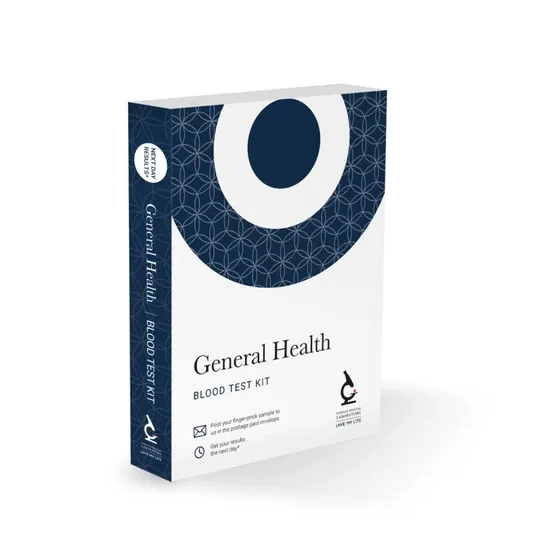
General Health Profile
Home kit with full cholesterol, HbA1c, liver, kidneys and iron. Add vitamin D in winter.
Home kitCollection pointResult in about 1 working daySee the test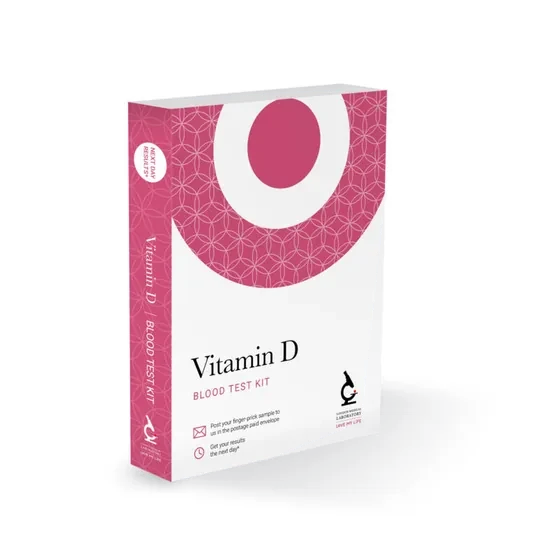
Vitamin D
Your 25(OH)D level, best checked in late winter.
Home kitCollection pointResult in about 1 working daySee the test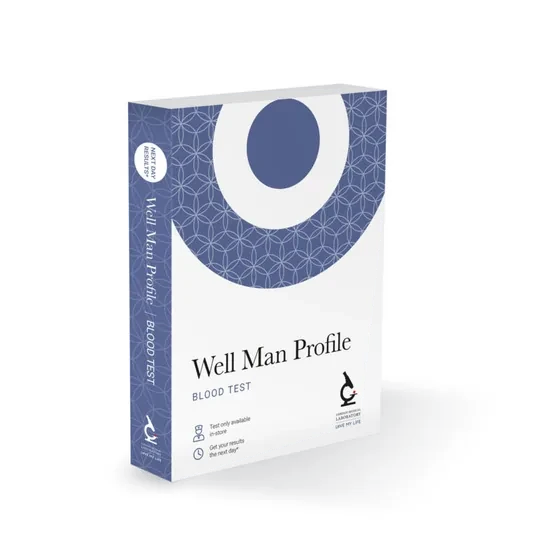
Well Man Premier Plus Profile
One test for all of it, adding blood count, ferritin, thyroid, vitamin D, B12, folate and testosterone. It needs a blood sample from a vein, at a collection point.
Collection pointResult in about 1 working daySee the test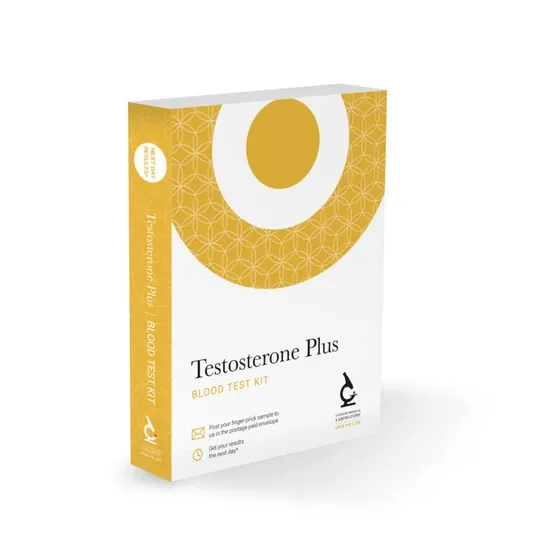
Testosterone Plus
Total and free testosterone with SHBG and albumin, if you have symptoms.
Home kitCollection pointResult in about 1 working daySee the test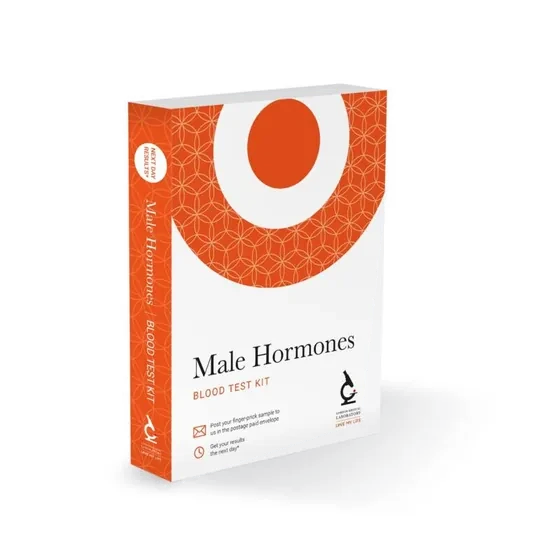
Male Hormones
Testosterone with LH, FSH, prolactin, oestradiol and DHEAS, if you have symptoms and your GP wants the wider picture.
Home kitCollection pointResult in about 1 working daySee the test
Prices are in the app, once you have an account.
What to do with your result
Your result arrives in your account, with reference ranges. A value outside the range, or a symptom with a normal result, is a conversation with your GP: treatment and supplements are their call. Repeat the same test later to compare.
Take the guide with you
The reasons, the tests and every reference, in a few pages. Free to download, no email needed.
See also
References
- 1.NHS. High cholesterol. nhs.uk. 2026. www.nhs.uk/conditions/high-cholesterol/
- 2.Akioyamen LE, Genest J, Shan SD, et al. Estimating the prevalence of heterozygous familial hypercholesterolaemia: a systematic review and meta-analysis. BMJ Open. 2017;7:e016461. doi:10.1136/bmjopen-2017-016461 PMID 28864697.
- 3.NHS. Type 2 diabetes: symptoms. nhs.uk. 2026. www.nhs.uk/conditions/type-2-diabetes/symptoms/
- 4.NHS. The 'male menopause'. nhs.uk. 2026. www.nhs.uk/conditions/male-menopause/
- 5.Wu FC, Tajar A, Beynon JM, et al. Identification of late-onset hypogonadism in middle-aged and elderly men. N Engl J Med. 2010;363:123-135. doi:10.1056/NEJMoa0911101 PMID 20554979.
- 6.NHS. Vitamin D. nhs.uk. 2026. www.nhs.uk/conditions/vitamins-and-minerals/vitamin-d/
- 7.Close GL, Russell J, Cobley JN, et al. Assessment of vitamin D concentration in non-supplemented professional athletes and healthy adults during the winter months in the UK: implications for skeletal muscle function. J Sports Sci. 2013;31:344-353. doi:10.1080/02640414.2012.733822 PMID 23083379.
- 8.NHS. NHS Health Check. nhs.uk. 2026. www.nhs.uk/tests-and-treatments/nhs-health-check/
- 9.NHS. Chlamydia. nhs.uk. 2026. www.nhs.uk/conditions/chlamydia/
General information, not personal medical advice. Talk to your GP about your own situation. Questions: write to [email protected] or message us in the app.