Blood tests for desk work: the numbers sitting moves
Long hours sitting and working indoors change cholesterol, blood sugar and vitamin D, usually without signs. A blood test shows your numbers, and a later one shows if moving more changed them.

Why it makes sense at this stage
What the research supports, with the source of each point at the bottom of the page.
- 01
Long hours sitting are linked to diabetes and heart disease, even if you exercise
In a review of 47 studies, long sitting time was linked to type 2 diabetes, heart disease and mortality, whatever the amount of exercise. In more than 1 million people, sitting was not linked to higher mortality in the most active group: moving more changes the picture.[1, 2]
- 02
Cholesterol and blood sugar rarely give signs
UK guidance works out heart risk from 25 to 84, with a cholesterol test that needs no fasting. It encourages a diabetes risk check from 40, or from 25 in higher-risk groups; an HbA1c of 42 to 47 mmol/mol means high risk.[3, 4]
- 03
People who work indoors have lower vitamin D
In a review by job, indoor workers averaged 40.6 nmol/L against 66.7 nmol/L for outdoor workers, and 78% were under 50 nmol/L. In the UK, sunlight is not enough from October to March.[5, 6]
- 04
Breaking up sitting changes blood sugar within hours
In a small trial, 2-minute walks every 20 minutes lowered blood sugar and insulin after a meal in adults with overweight. UK guidance asks you to break up long periods of sitting. A test gives you the starting point.[7, 8]
- 05
The NHS Health Check starts at 40, every 5 years
The NHS check is for people aged 40 to 74, invited every 5 years, with a cholesterol test and possibly a blood sugar test. Under 40, or to follow your numbers more closely, a blood test is how you know them.[9]
The tests and why
What usually makes sense for this group. Your GP can tell you what fits your own case.
Cholesterol (total, LDL, HDL, non-HDL, triglycerides)
High cholesterol usually gives no signs; a blood test is how you know your number. You do not need to fast.[1, 3, 9]
When to repeat: From 25, for the risk check with your GP; after changing habits, to compare.
HbA1c (average blood sugar)
Your average blood sugar over the past two to three months. Long hours sitting are linked to type 2 diabetes.[1, 4, 7]
When to repeat: From 40, or from 25 in higher-risk groups (South Asian, Chinese, African-Caribbean or Black African background), as your GP advises.
Vitamin D, 25(OH)D
Indoor workers tend to have lower vitamin D, and UK sunlight is too weak from October to March.[5, 6, 10]
When to repeat: Late autumn or winter.
Liver, kidneys and uric acid
A general check of liver and kidneys, useful as a baseline alongside cholesterol and blood sugar.
When to repeat: With your general panel.
What a blood test can and cannot do
It can
- Show your cholesterol and blood sugar, which rarely give signs
- Give you a starting point to see if moving more changes your numbers
- Show your vitamin D after a winter indoors
It cannot
- Give your heart risk on its own: your GP's calculation also uses age, blood pressure and smoking
- Show that sitting is not harming you: the link is long term
- Prove that a standing desk lowers cholesterol: there is no checked source for that
Tests that cover these markers
Not sure which one? The guided check-up suggests a starting point in a few questions.
Find your check-up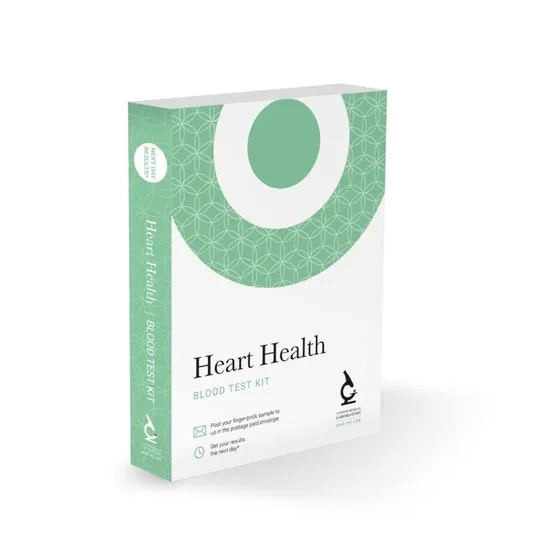
Heart Health Profile
Full cholesterol and HbA1c, the two numbers sitting moves, with a home kit or at a collection point.
Home kitCollection pointResult in about 1 working daySee the test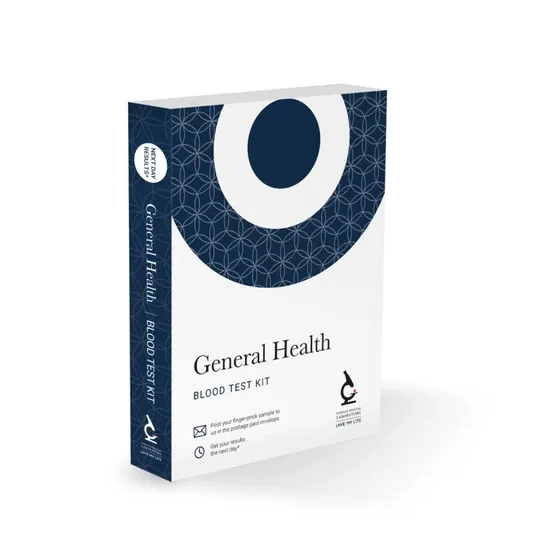
General Health Profile
Full cholesterol and HbA1c, with liver, kidneys, uric acid, calcium and iron. It has no vitamin D, so add it below.
Home kitCollection pointResult in about 1 working daySee the test
Vitamin D
Your 25(OH)D level, best checked in late autumn or winter.
Home kitCollection pointResult in about 1 working daySee the test
Prices are in the app, once you have an account.
What to do with your result
Your result arrives in your account, with reference ranges. A value outside the range, or a symptom with a normal result, is a conversation with your GP: treatment and supplements are their call. Repeat the same test later to compare.
Take the guide with you
The reasons, the tests and every reference, in a few pages. Free to download, no email needed.
See also
References
- 1.Biswas A, Oh PI, Faulkner GE, et al. Sedentary time and its association with risk for disease incidence, mortality, and hospitalization in adults: a systematic review and meta-analysis. Ann Intern Med. 2015;162:123-132. doi:10.7326/M14-1651 PMID 25599350.
- 2.Ekelund U, Steene-Johannessen J, Brown WJ, et al. Does physical activity attenuate, or even eliminate, the detrimental association of sitting time with mortality? A harmonised meta-analysis of data from more than 1 million men and women. Lancet. 2016;388:1302-1310. doi:10.1016/S0140-6736(16)30370-1 PMID 27475271.
- 3.NICE. Cardiovascular disease: risk assessment and reduction, including lipid modification (NG238). nice.org.uk. 2023. www.nice.org.uk/guidance/ng238/chapter/Recommendations
- 4.NICE. Type 2 diabetes: prevention in people at high risk (PH38). nice.org.uk. 2017. www.nice.org.uk/guidance/ph38/chapter/Recommendations
- 5.Sowah D, Fan X, Dennett L, Hagtvedt R, Straube S. Vitamin D levels and deficiency with different occupations: a systematic review. BMC Public Health. 2017;17:519. doi:10.1186/s12889-017-4436-z PMID 28637448.
- 6.NHS. Vitamin D. nhs.uk. 2026. www.nhs.uk/conditions/vitamins-and-minerals/vitamin-d/
- 7.Dunstan DW, Kingwell BA, Larsen R, et al. Breaking up prolonged sitting reduces postprandial glucose and insulin responses. Diabetes Care. 2012;35:976-983. doi:10.2337/dc11-1931 PMID 22374636.
- 8.UK Chief Medical Officers. UK Chief Medical Officers' Physical Activity Guidelines. gov.uk. 2019. www.gov.uk/government/publications/physical-activity-guidelines-uk-chief-medical-officers-report/uk-chief-medical-officers-physical-activity-guidelines
- 9.NHS. NHS Health Check. nhs.uk. 2026. www.nhs.uk/tests-and-treatments/nhs-health-check/
- 10.Scientific Advisory Committee on Nutrition. Vitamin D and Health. Public Health England. 2016. www.gov.uk/government/publications/sacn-vitamin-d-and-health-report
General information, not personal medical advice. Talk to your GP about your own situation. Questions: write to [email protected] or message us in the app.