Planning a baby: the tests that help, and the ones you can skip
Folic acid and vitamin D are supplements the NHS advises for everyone, with no test needed. A blood test helps with rubella immunity, iron and, with symptoms, the thyroid.

Why it makes sense at this stage
What the research supports, with the source of each point at the bottom of the page.
- 01
Folic acid starts before pregnancy, and it is for everyone
The NHS advises 400 micrograms a day, ideally from about three months before trying until week 12; it lowers the chance of a neural tube defect such as spina bifida. Some people need 5 milligrams, prescribed by their GP. It depends on starting early, not on a test.[1]
- 02
Rubella is no longer checked in pregnancy, so before is the time
England stopped rubella immunity screening in pregnancy on 1 April 2016; the advice is to have the MMR vaccine before you get pregnant. If you are not sure you had it, ask your GP. If you have the vaccine, wait 1 month before trying.[2, 3, 4, 5]
- 03
Fertility belongs to both of you
After 1 year of trying without a pregnancy, UK guidance says both partners should be assessed.[6]
- 04
Some popular tests do not help before you start trying
UK guidance says not to use AMH to predict natural pregnancy, and a study of 750 women aged 30 to 44 found no difference in the chance of pregnancy between low and normal AMH. Knowing what not to measure saves worry.[5, 7]
The tests and why
What usually makes sense for this group. Your GP can tell you what fits your own case.
Folic acid and vitamin D: supplements, not tests
Take 400 micrograms of folic acid a day, ideally from about three months before trying until week 12. In pregnancy the NHS also advises 10 micrograms of vitamin D a day from early October to late March. No blood test is needed to start either.[1]
When to repeat: No test needed.
Rubella immunity (IgG antibody)
Rubella early in pregnancy can harm the baby, and the NHS no longer checks your immunity in pregnancy. If you are not sure you had two doses of MMR, ask your GP for your records or check your immunity before you try.[2, 3, 4, 5]
When to repeat: Once. If you are not immune, your GP gives the vaccine free, and you wait 1 month before trying.
Full blood count, ferritin and thyroid
Heavy periods can lower your iron, and UK guidance recommends a full blood count when periods are heavy. The thyroid is checked only if you have symptoms.[5, 8]
When to repeat: As your GP advises.
Day 21 progesterone, FSH and LH: once tests have started
After a year of trying, your GP looks at both of you. A mid-cycle progesterone test (day 21 of a 28-day cycle) checks ovulation, and FSH and LH are for irregular cycles. Before that, these tests are not needed.[5, 6]
When to repeat: As your GP advises.
Sexually transmitted infections (both partners)
If either of you thinks you may have an STI, get tested before you try. HIV, hepatitis B and syphilis are also checked by the NHS early in pregnancy.[3, 9]
When to repeat: Depending on risk; the NHS checks again in pregnancy.
For men: the first test is not a blood test
For men, the first fertility test is a semen analysis, arranged through your GP. A blood test for testosterone does not replace it.[5]
When to repeat: As your GP advises.
Medicines and anabolic steroids (both partners)
Tell your GP about any testosterone, finasteride, anabolic steroids or cannabis: they can affect fertility.[10]
When to repeat: A conversation, not a test.
What a blood test can and cannot do
It can
- Check your rubella immunity before you try
- Show whether heavy periods have lowered your iron
- Check ovulation once your GP starts looking into fertility
It cannot
- Tell you how fertile you are: AMH and FSH do not predict natural pregnancy
- Decide whether you need folic acid: the NHS advises it for everyone trying
- Give your chance of getting pregnant: no blood test does that
Tests that cover these markers
Not sure which one? The guided check-up suggests a starting point in a few questions.
Find your check-up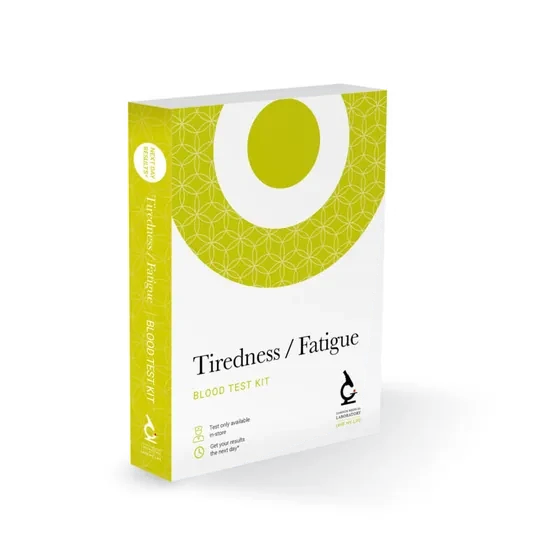
Tiredness and Fatigue Profile
For heavy periods: full blood count, ferritin, vitamin D and thyroid. At a collection point.
Collection pointResult in about 1 working daySee the test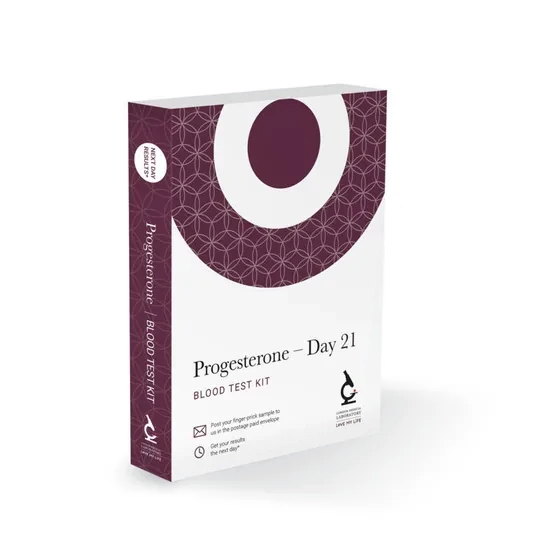
Progesterone
Checks ovulation on day 21 of a 28-day cycle. After a year of trying, with your GP.
Home kitCollection pointResult in about 1 working daySee the test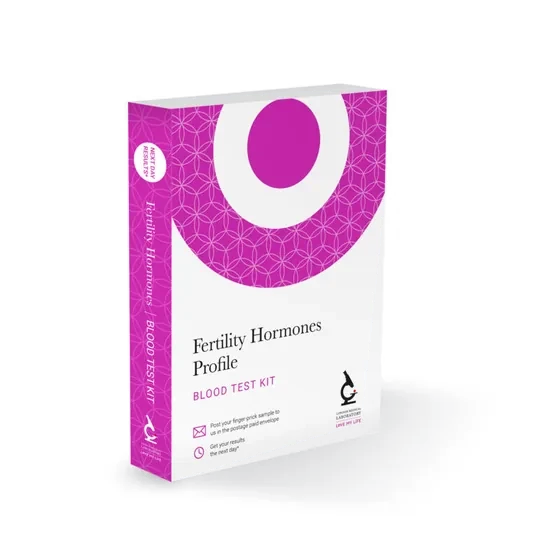
Fertility Hormones
FSH, LH, oestradiol, testosterone and prolactin. Only for irregular cycles, after a year of trying, with your GP.
Home kitCollection pointResult in about 1 working daySee the test
Prices are in the app, once you have an account.
What to do with your result
Your result arrives in your account, with reference ranges. A value outside the range, or a symptom with a normal result, is a conversation with your GP: treatment and supplements are their call. Repeat the same test later to compare.
Take the guide with you
The reasons, the tests and every reference, in a few pages. Free to download, no email needed.
See also
References
- 1.NHS. Vitamins, supplements and nutrition in pregnancy. nhs.uk. 2026. www.nhs.uk/pregnancy/keeping-well/pregnancy-vitamins-and-supplements/
- 2.Public Health England. Rubella susceptibility screening in pregnancy to end in England. gov.uk. 2016. www.gov.uk/government/news/rubella-susceptibility-screening-in-pregnancy-to-end-in-england
- 3.NHS. Planning your pregnancy. nhs.uk. 2026. www.nhs.uk/pregnancy/trying-for-a-baby/planning-your-pregnancy/
- 4.NHS. Rubella. nhs.uk. 2026. www.nhs.uk/conditions/rubella/
- 5.NICE. Fertility problems: assessment and treatment (NG257). Investigation of fertility problems and management strategies. nice.org.uk. 2026. www.nice.org.uk/guidance/ng257/chapter/Investigation-of-fertility-problems-and-management-strategies
- 6.NICE. Fertility problems: assessment and treatment (NG257). Defining infertility and initial assessment. nice.org.uk. 2026. www.nice.org.uk/guidance/ng257/chapter/Defining-infertility-and-initial-assessment
- 7.Steiner AZ, Pritchard D, Stanczyk FZ, et al. Association Between Biomarkers of Ovarian Reserve and Infertility Among Older Women of Reproductive Age. JAMA. 2017;318:1367-1376. doi:10.1001/jama.2017.14588 PMID 29049585.
- 8.NICE. Heavy menstrual bleeding: assessment and management (NG88). nice.org.uk. 2026. www.nice.org.uk/guidance/ng88/chapter/Recommendations
- 9.NHS. Screening tests in pregnancy. nhs.uk. 2026. www.nhs.uk/pregnancy/your-pregnancy-care/screening-tests/
- 10.NICE. Fertility problems: assessment and treatment (NG257). Advice about factors that can affect fertility. nice.org.uk. 2026. www.nice.org.uk/guidance/ng257/chapter/Advice-about-factors-that-can-affect-fertility
General information, not personal medical advice. Talk to your GP about your own situation. Questions: write to [email protected] or message us in the app.